




Navistar's 'Clean Sheet' Integrated Powertrain Promises Efficiency, Reliability
The new International S13 Integrated Powertrain is Navistar’s most efficient ever and the first product in Traton's new modular approach to developing global products.


Navistar, working with Traton, took a "clean sheet" approach to the new International S13 Integrated Powertrain.
Photo: Deborah Lockridge
The new International S13 Integrated Powertrain is Navistar’s most efficient ever — and by taking a different approach to lowering both carbon and EPA-pollutant emissions, it promises to address some of the maintenance and reliability headaches fleets have dealt with since the EPA 2007 and 2010 engines came on the scene.
Dealers, customers and media were introduced to the International S13 Integrated Powertrain Aug. 16 during a live event at the Las Vegas Motor Speedway.
Company officials called the S13 powertrain a milestone in its movement toward carbon neutral transport. But it also will be the last internal combustion engine it ever designs.
The new powertrain is being introduced in the International LT and RH models as the standard offering. Orders are scheduled to open in October.
Modular Approach
With the global resources of its new parent company Traton, in particular working with Scania, engineers took a “clean sheet” approach to the design.
Developed over five years through global collaboration with the Traton Group, the S13 Integrated Powertrain will provide superior fuel economy, performance, and simplicity and serviceability to the North American commercial vehicle market, according to the company.

Attendees to the S13 launch event got a chance to take a spin around the track.
Photo: Deborah Lockridge
The powertrain consists of three components, developed and integrated concurrently:
S13 13L engine
T14 14-speed automated manual transmission
Dual Stage Aftertreatment with a dual-stage SCR catalyst system in a one-box design.
This is the first demonstration of Traton Group’s new modular approach, which allows for mass customization of broad variant offerings across Traton’s global product range. That means faster time to market and lower production costs. The modular system cross-brand development and production, while still allowing for regional adaptation and validation of the S13 Integrated Powertrain for the North American market.
“The group solution is based on commonality,” explained Matthias Carlbaum, president and CEO, encouraging the audience to think about it as Legos building blocks. “On a global scale brings you world-leading technology at a speed that never would have been possible otherwise.”
There is a high degree of commonality between the new S13 and the Scania 13L recently introduced.

Navistar, working with Traton, took a "clean sheet" approach to the new International S13 Intgrated Powertrain.
Photo: Navistar
The modular design allows each component to focus on its job, explained Dave Hillman, director of integrated powertrain marketing. Because the engine is focusing on power generation and not on “cleaning up after itself,” he said, it can operate more efficiently, with simplified design and components that reduce weight, improve efficiency, and improve reliability. Instead, the aftertreatment system handles the task of reducing emissions out the tailpipe.
The S13 Integrated Powertrain will be manufactured at Navistar’s Huntsville Powertrain Manufacturing Plant in Huntsville, Alabama.
This powertrain is already in use at Traton sister companies. But Hillman offered an example of how the collaborative design approach works. A front-engine power takeoff, or FEPTO, is common in North America but not seen in Europe. But International will have FEPTO availability when it offers the new powertrain in its vocational models. “That’s an example of how our engineers have been working hand in hand, as opposed to just bringing in someone else’s design. We’ve had our engineers involved since day one.”
Engine Design
The 13L International S13 engine achieves advanced fuel efficiency and performance through combustion efficiency and a reduction of friction and pumping losses.

The 13L International S13 engine achieves advanced fuel efficiency and performance through combustion efficiency and a reduction of friction and pumping losses.
Photo: Navistar
It operates on low revolutions and higher torque, meaning fewer fuel injections and less fuel consumption. Designed with selective catalytic reduction (SCR) technology as the primary emissions reduction technology, the S13 engine has no exhaust gas recirculation (EGR) cooler and flows 100% of the exhaust to the turbocharger in normal engine operating conditions. This delivers more power and improved engine performance. Eliminating the recirculation of exhaust gas ensures a more complete fuel burn and allows cleaner air to enter the combustion chamber on the intake cycle to mitigate soot buildup.
There is still EGR in the system, explained Hillman, but it used to keep the catalyst warm, not for power generation.
“A big benefit of eliminating that EGR cooler is the way we generate the power,” Hillman said. If 20% of that energy is diverted to the EGR cooler in a traditional engine, that means only 80% of your energy is going into the turbocharger. With the S13, 100% of that energy is going into the turbocharger. That allows the use of a fixed-geometry turbocharger rather than the variable-geometry being commonly used. “The more robust design solves a pain point for customers.”
Low-friction materials and finishes are used for liners, rings and bearings. The design eliminated the downstream fuel injector, and the high-pressure fuel pump operates at a lower pressure of 1,800 bar. Additional features include a dual overhead cam design and cast aluminum cam cover and oil pan, 23:1 compression ratio and a compression release brake with maximum braking power of 469 hp for maximum engine braking power.
The compacted graphite iron block of the S13 engine, combined with a cast aluminum cam cover and oil pan (which protect against corrosion) help make this the lightest weight 13L powertrain available in North America, according to International.
The S13 engine has seven engine rating options, with a maximum 515 hp and 1,850 lb-ft of torque at 2,000 rpm.
Transmission Features
The International T14 is the first commercial transmission offered by International. It’s a 14-speed fully automated manual transmission with an electronic clutch actuator to deliver faster, smoother shifting.
The T14 features a planetary gear set that supports a compact design and optional programmable reverse speeds. This transmission has two crawler gears for improved heavy load startability and low-speed maneuvering. Complete with deep low-end gearing and shifting smoothness, the T14 delivers efficiencies of a direct drive in an overdrive package.

The International T14 is the first commercial transmission offered by International.
Photo: Navistar
The S13 Integrated Powertrain offers increased power, with the full torque available at 900 RPM to support drivability. Drivers have shift-on-the-fly capabilities with Economy, Performance and Performance+ modes. Also included are intelligent shifting capabilities, like skip shifting and turning radius offsets.
In addition to multiple shifting capabilities, the T14 transmission includes options for low-speed maneuvering, hill hold, and initial vehicle movement modes.
Aftertreatment System
The compact design of the Dual Stage Aftertreatment is purpose built with easy access for serviceability, as well as significantly improved emissions control and fuel efficiency.
To keep temperatures at an optimal range and extend service intervals, the aftertreatment system includes a dual-stage SCR catalyst system in a one-box design.

The aftertreatment system uses a dual-dose SCR to remove NOx emissions, as well as a diesel particulate filter.
Photo: Deborah Lockridge
Since an EGR cooler was eliminated from the combustion process, less soot and particulate matter are generated. This cleaner combustion cycle allows for extended service intervals and eliminates the need for active regeneration cycle and the diesel oxidation catalyst. By employing a design that eliminates the need for active diesel particulate filter regeneration, the Dual Stage Aftertreatment system saves fleets time and fuel.
“To ensure superior performance and reliability of the S13 Integrated Powertrain, it’s been designed to meet the toughest requirements of the North American market,” said Grahe. “Before this integrated powertrain goes into serial production, this product will have logged more than 4 million miles of field testing on North American roads. We are testing on all terrains – from the desert of Arizona to the frozen tundra of Alaska.”
Comprehensive Ownership Solutions
The International S13 Integrated Powertrain includes several customer benefits outside of the product itself, including dealer integrated software, built-in service products, repair maintenance contracts and other solutions.
OnCommand Connection, Navistar’s connected services platform, will come standard and offer programmable parameters, over-the-air calibration changes and software updates. The powertrain’s predictive capabilities help fleet owners and service managers stay ahead of potential service needs. International 360, Navistar’s service communications tool designed to accelerate the repair process and streamline dealer communications, is also an available option.
This combines fleet monitoring and preventive maintenance to increase uptime, have fewer unplanned events and extend service intervals, according to Navistar.
Strategic Initiatives
Carlbaum outlined three of Navistar’s core strategic initiatives for the coming five years that are relevant to the S13:
1. Sustainability. By 2030, 50% of Navistar’s new sales vehicles will be zero emissions. By 2040 this number will be 100%. “We’re here today launching an internal combustion engine. There’s no conflict in that,” he said. “On the contrary, the internal combustion engine will be required for many years until the electrical vehicle can be fully adopted when we have an available cross country infrastructure. So as a group we designed the S13 powertrain to ensure it’s as sustainable as possible without compromising anything on performance.”
That said, however, he added, “This is the last internal combustion engine that we will ever develop.”.
2. Uptime. “We are making a noticeable shift from offering product to providing solutions,” he said, such as predictive maintenance, predictive repairs, leasing solutions, and connectivity to lower the risk truck owners must take on.
3. Expansion of captive financial services. Starting in 2023, Navistar will offer wide range of financing and leasing solutions to customers and dealers.
More Equipment
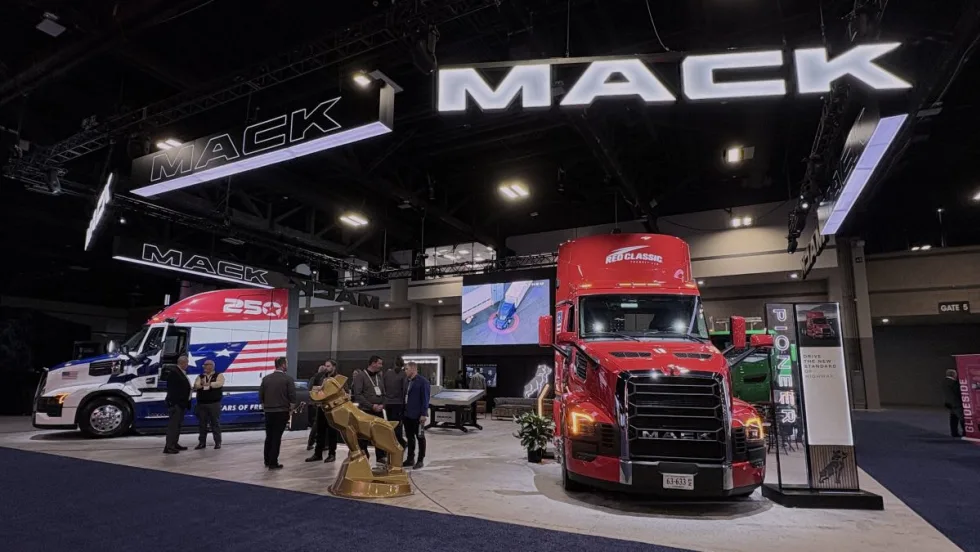
Trucks at ATA's 2026 MC&E in Charlotte, North Carolina [Photos]
From rigs decked out in patriotic America's 250 paint schemes to autonomous trucks and more, check out these photos from ATA's 2026 Management Conference & Exhibition.
Read More →
Help HDT Find Trucking’s Top Products
Have you come across a new product that could make a difference for trucking fleets? Nominate it for HDT’s 2027 Top 20 Products Awards by November 9.
Read More →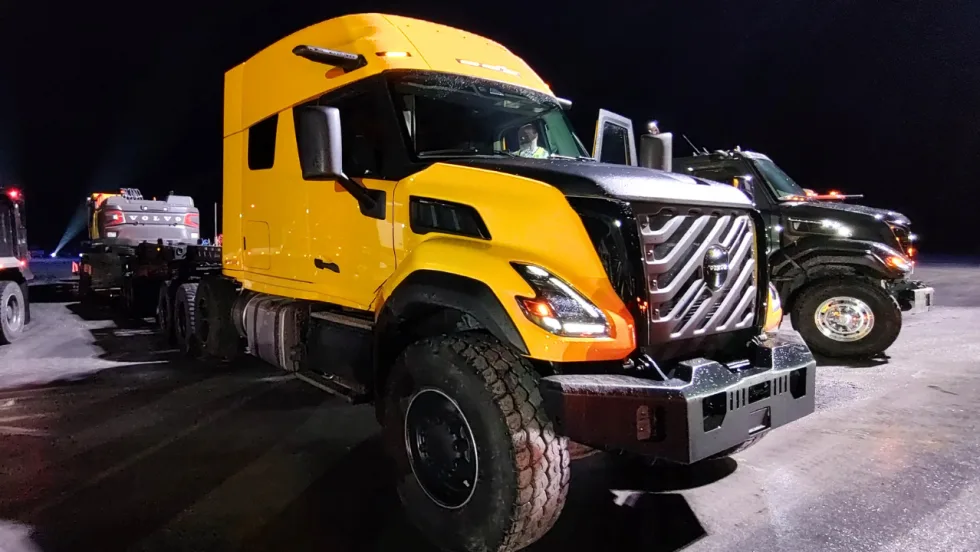
Volvo Unveils New VNX Heavy-Haul and Vocational Truck
Volvo Trucks has launched the VNX, a new vocational truck also available as a tractor in day cab and two sleeper configurations, with one heavy-haul model. The Volvo VNX is powered by Volvo's D13 platform, which delivers up to 540 horsepower and 1,950 pound-feet of torque and is EPA 2027-compliant.
Read More →
How GP Transco Cuts Trucking Fuel Costs, a Tenth of a Gallon at a Time
What’s another tenth of a mile per gallon worth? GP Transco shares how equipment upgrades and driver coaching turn small gains into meaningful fuel savings.
Read More →
Electric Yard Tractors Move Beyond Pilots
Operating-cost savings have overtaken sustainability goals as the leading reason surveyed fleets are adopting battery-electric terminal tractors, according to new NACFE research.
Read More →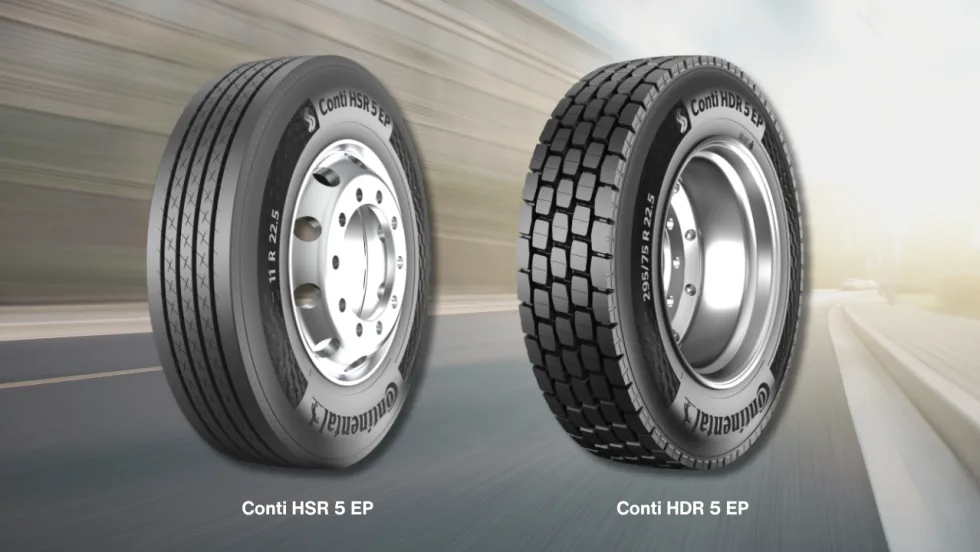
Continental Introduces New Regional Truck Tires
Continental says its new Generation 5 steer and drive tires for regional operations offer longer tread life, with estimated mileage gains of 22% and 19%, respectively.
Read More →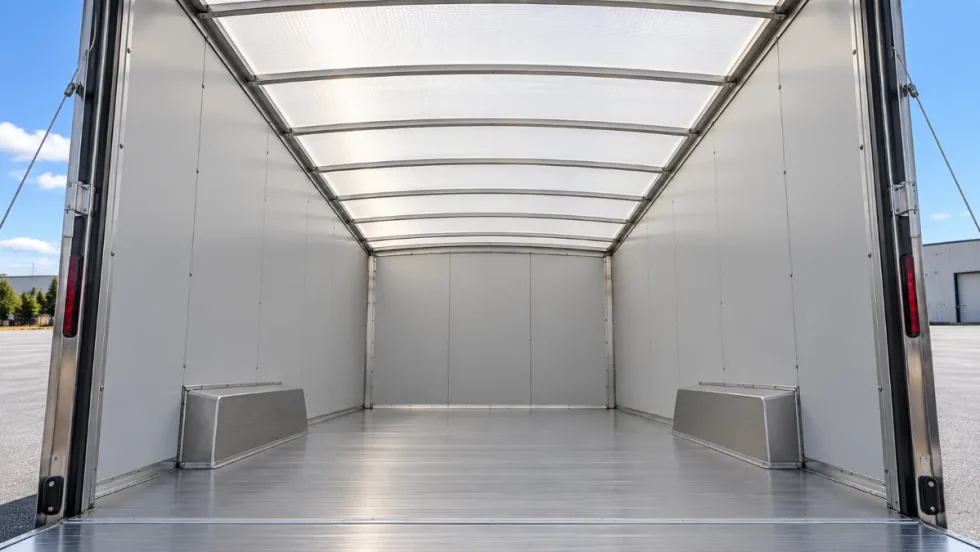
Tekmodo Introduces CargoBright Brand for Translucent Trailer Roofs
CargoBright is designed to diffuse daylight across the cargo area while performing as a working vehicle roof.
Read More →
Fleet Economics Shape Electric Truck Outlook
ACT Research expects costs, charging infrastructure, and technology improvements to drive zero-emission commercial vehicle adoption as federal regulations and incentives retreat.
Read More →
Kodiak Targets Dallas–Houston for Driverless Trucks
The company says its autonomous trucks are completing the I-45 run without a safety observer taking control. It plans to remove the observer by the end of 2026.
Read More →
Kodiak Hauls Produce in California Autonomous Truck Pilot
Kodiak AI and DTL Transport have begun hauling produce between Fresno and Los Angeles under California’s new rules for testing heavy-duty autonomous trucks. A safety driver remains behind the wheel.
Read More →